Showing posts with label pmbok. Show all posts

Wednesday, September 10, 2014

Project Management Process Groups & Knowledge Areas for PMP Certification

One of the basic concepts of PMBOK are the Project Management Process Groups and Project Management Knowledge Areas. For the PMP Certification exam, you need to know each of the process groups and knowledge areas and the mapping between the Project Management process groups and knowledge areas. So let's begin.

There are five Project Management process groups - Initiation, Planning, Execution, Monitoring and Control and Closing.


There are nine Project Management Knowledge Areas
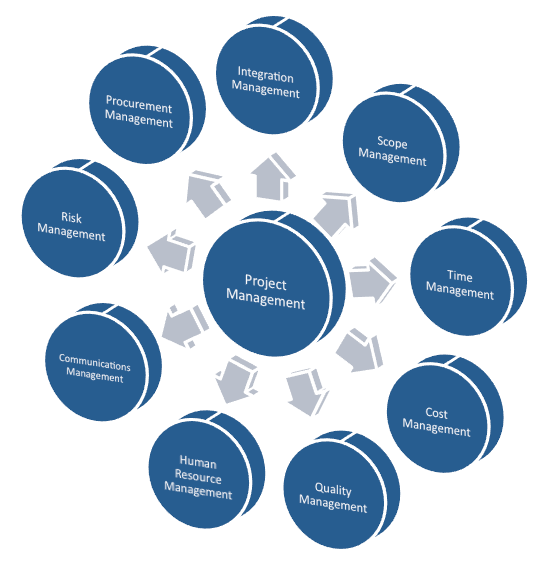
  1. Integration Management
  2. Scope Management
  3. Time Management
  4. Cost Management
  5. Quality Management
  6. Human Resource Management
  7. Communications Management
  8. Risk Management
  9. Procurement Management


For the PMP Certification exam, you will need to know the each of the tasks under the individual process groups as well as which of these tasks map to which Project Management Knowledge area. Note that Integration Management is the only knowledge area which has tasks in all the process groups. Hence it is the most important chapter in PMBOK as well as the PMP certification exam. 


Monday, September 30, 2013

Pareto's law in Project Management

CAPM Test Question/PMP Test Question regarding Pareto's Law
12. What is Pareto's Law?
A.     80% of the effects come from 20% of the causes
B.     Work expands so as to fill the time available for its completion.
C.     Anything that can go wrong will go wrong.
D.     Never attribute to malice that which can be adequately explained by stupidity.
Answer: A - Pareto's Law says that 80% of the effects come from 20% of the causes. Vilfredo Pareto, an Italian Economist, observed in his country that twenty percent of the people owned eighty percent of the wealth. The poor were lucky then - today it's more like 10/85. Management thinker Joseph Juran (1904 - 2008!) was the one who actually came up with this concept as it applies to business and named it after Pareto.

We’ll go through the other ones since they’re kind of fun to know:

B, "Work expands so as to fill the time available for its completion" is Parkinson's Law. That's another good one to know.

C, is Murphy's Law. Sometimes it may seem like "Anything than can go wrong will", but it isn't necessary a good philosophy to have!

D, "Never attribute to malice that which can be adequately explained by stupidity." is Hanlon's Razor. This isn't in the project manager's handbook for good reason. It's easier to work with a team when you have a healthy respect for them. Nevertheless, you can keep this in the hip pocket for an opportune time.


Key Takeaway: This is a handy heuristic to help you focus your attention on the most important things a project entails, allowing him/her to manage key risks and satisfy the most important stakeholders. Other examples: 20% of your customers will cause 80% of you problems. 20% of items in inventory represent 80% in sales. And so on.

One application I'm sure you'll find interesting is that 80% of beer is drunk by 20% of consumers. That's why most beer commercials are concentrated on football and tawdry men's magazines. It just makes sense for those companies to focus on their heavy consumers.

Friday, September 27, 2013

Gold-plating in Project Management

I came across a new project management term today called "Gold plating" in a CAPM Test question. Had never come across this term before so I looked up the definition.

Gold plating in software engineering or Project Management (or time management in general) refers to continuing to work on a project or task well past the point where the extra effort is worth the value it adds (if any). After having met the requirements, the developer works on further enhancing the product, thinking the customer would be delighted to see additional or more polished features, rather than what was asked for or expected. The customer might be disappointed in the results, and the extra effort by the developer might be futile.
Gold plating is also considered as a bad project management practice for different project management best practices and methodologies such as: Project Management Body of Knowledge (PMBoK) and Prince 2. In this case, gold plating refers to the addition of any feature not considered in the original scope plan (PMBoK) or business case (Prince2) at any point of the project since it introduces a new source of risks to the original planning i.e. additional testing, documentation, costs, timelines, etc. However, gold plating does not prevent new features from being added to the project, they can be added at any time as long as they follow the official change procedure and the impact of the change in all the areas of the project is taken into consideration.

The CAPM test question is as below: