Wednesday, December 3, 2014

5 Must-have Apps for Samsung Galaxy S5 for power users

It has been about 3 months since I starting using Samsung Galaxy S5. Here are my top 5 picks for Samsung Galaxy S5

1.Google Keep
This is similar to Notes but because it is Google, you can have access to your notes from your desktop browser as it is synced with the Google Account. You can use Google Keep app for all kinds of stuff, storing memos, lists, recipes, random articles, URLs to news articles etc. You can color code your notes to differentiate memos from recipes. What I really like is the list feature which automatically strikes off an item when I click on the check-box. That makes grocery shopping super easy. It also has a search feature within the notes which makes it easy for you to search among thousands of notes.  

2. Push Bullet
I absolutely love the Push Bullet app. I frequently use multiple devices, my desktop at home, my work computer and the phone. If I am reading an interesting article on my desktop or find a recipe for example, and I want to save it on my phone, the only ways to do that is email it to yourself or type the link on your phone. With Push bullet, you can install an extension in your browser and by the click of a button it sends the article that you are reading to your phone or any other device. The same applies to your phone, if you are reading an article on your phone you can push it to any other device. It isnt limited to just articles, you can push photos, videos, notes etc. You can also push it to your family's devices. So I frequently share articles using push bullet with my family as well.

3. CamScanner
I frequently have to scan documents. But its a tedious process on the scanner. So the CamScanner app allows you to take a picture and then converts it to a scanned document. Best part is even if the picture is a little distorted or angled incorrectly or the lighting is not right, the app adjusts everything and makes it look like an actual scan.

4. Beep'nGo
This is a Samsung native App, so download it from the Samsung Apps store. Love this app because it has all the offers in one place, no need to search for coupons! Beep'nGo app has offers on apparels, dining, grocery and automobiles. Plus, you can also scan your own coupons with the bar codes and you never have to carry them again. You can also scan your gift cards along with their bar codes so you can use the gift cards from your phone and never have to carry them in your wallet!

5. NightCamera
Honestly, Samsung Galaxy S5 has a great camera but it does not take good pictures at night. If you are a party animal who loves to take pictures in the dark or at night, you are better off with the IPhone. IPhone has way better picture quality at night than the Samsung Galaxy S5. So I have installed the NightCamera app which takes a good night picture. The only thing annoying about this app is the advertisement, but hey, if that's what keeps it free, then I am ok with it. ;)


Thursday, October 30, 2014

Business Case Development Template and Guidelines

Before we get into the details of business case development, it is important to understand what is a business case, why do we prepare business cases, and how much time should we be spending on developing a business case.

What is a Business Case?

A business case serves as the center piece in integrating IT governance, portfolio management processes, and financial management processes. Business cases are an important document in helping leadership and management understand the business value of an investment or business opportunity. A business case is part sales and part marketing. But it is the “business” units’ opportunity to present an overwhelming and compelling justification for funding an investment to achieve organization or business unit mission, goals, and objectives.

An effective business case is a multi-purpose document that generates the support, participation and leadership commitment required to transform an idea into reality. A business case identifies an idea, problem, or opportunity. It provides context and content around the problem and equally illustrates the desired objectives and outcomes. The problem and desired outcomes are normally defined and described in terms of the business. The business case describes how and who will be affected. The how and who typically evolve around individual or organization behavioral changes; also know as change management. Change management also involves the people and process changes that would be required. The business case will breakout specific alternatives that were examined, their associated impacts, risks, costs, and benefits. Alternatives focus more towards a technical component contributing to the overall business solution.

Business case development is a collaborative effort:
·         It is business driven, lead by the business or program area that is making the proposal,
·         Information technology representative(s) form the Office of Information Services,
·         Change management representative(s) from the Office of Information Services, Business Process Engineering Unit,
·         Financial analyst representative(s) from Finance Policy and Analysis,
·         Any (all) stakeholders who will be impacted by the proposal, and to ensure approval and ongoing support
·         And a benefits sponsor.

Why Prepare a Business Case?

The simple answer to the question of “why?” would be:  1. it makes sense, 2. it is the right thing to do, and 3. business cases are recognized and accepted as a best practice.

Those three reasons either alone or together may not appear to be compelling enough. Below are more concrete requirements as to “why” we prepare business cases, founded upon statute and policy.

Governor’s Priorities and Initiatives:  In response to the current budget crisis and in support of the Governor’s priorities to “Restore Confidence and Accountability in Government” and “Make Government Live within its Means,” the Governor’s initiative on Regulatory Streamlining, and the activities of the Governor’s Advisory Committee on Government and Performance and Accountability, the Department of Administrative Services (DAS) and state agencies must do what we can to appropriately control information technology (IT) spending and stretch limited IT dollars.

Business cases are fundamental in identifying accountable business or benefit owner(s), high level business performance metrics, and the associated investment cost model.

How much time to spend on developing a business case?

General Rule of thumb: Business case time = approximately 5-10% of anticipated implementation project time. An anticipated:
  • 25 day project to implement the business opportunity = 2 days to put together a complete but straightforward and simple business case
  • 3 month project to implement the business opportunity = 9 days to put together an appropriately detailed business case
  • 1 year project to implement the business opportunity = 1 – 1.5 months to put together a detailed business case
  • 3 year project to implement the business opportunity = 3 months to put together a comprehensive business case
The Business case template is scalable to the nature and impact of the proposal.  The number of pages of a business case varies based on the subject matter of the case. It may be a brief 2-4 page document or an extensive evaluation consisting of 20 to100 pages. However, the length of the business case should be kept to a minimum, ensuring it stays on topic, presents relevant information in a clear and concise manner, and is focused on supporting management in making decisions. The time and effort spent on a business case should be in proportion to the scope of the problem.The definitive answer for the amount of time allocated to develop a business case is:  It takes as long as it takes. It is a function of time, commitment, understanding, and resources.

Business Case Template
At a minimum, the business case shall include the following sections:

  • Executive Summary
  • Introduction & Background
  • Problem Definition & Desired Business Goal(s) and Objectives
  • Alternatives
    • Assumptions
    • Benefits Estimates, and Benefit Metrics
    • Cost Estimates
    • Risk Assessment
  • Financial Analysis
  •  Recommendation
  • Implementation Approach/Timeline
  • Appendices

Wednesday, September 10, 2014

Project Management Process Groups & Knowledge Areas for PMP Certification

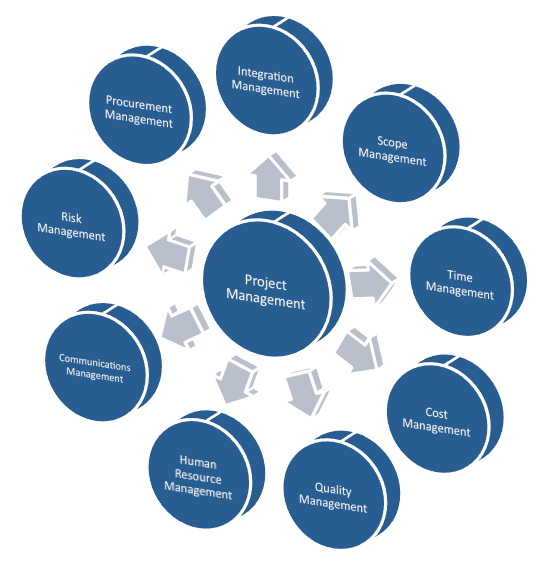
One of the basic concepts of PMBOK are the Project Management Process Groups and Project Management Knowledge Areas. For the PMP Certification exam, you need to know each of the process groups and knowledge areas and the mapping between the Project Management process groups and knowledge areas. So let's begin.

There are five Project Management process groups - Initiation, Planning, Execution, Monitoring and Control and Closing.


There are nine Project Management Knowledge Areas

  1. Integration Management
  2. Scope Management
  3. Time Management
  4. Cost Management
  5. Quality Management
  6. Human Resource Management
  7. Communications Management
  8. Risk Management
  9. Procurement Management


For the PMP Certification exam, you will need to know the each of the tasks under the individual process groups as well as which of these tasks map to which Project Management Knowledge area. Note that Integration Management is the only knowledge area which has tasks in all the process groups. Hence it is the most important chapter in PMBOK as well as the PMP certification exam. 


Tuesday, July 8, 2014

W3schools PHP Quiz Questions and Answers

PHP QUIZ
1. What does PHP stand for?
You answered:
PHP: Hypertext Preprocessor
 Correct Answer!

2. PHP server scripts are surrounded by delimiters, which?
You answered:
<?php…?>
 Correct Answer!

3. How do you write "Hello World" in PHP
You answered:
echo "Hello World";
 Correct Answer!

4. All variables in PHP start with which symbol?
You answered:
$
 Correct Answer!

5. What is the correct way to end a PHP statement?
You answered:
;
 Correct Answer!

6. The PHP syntax is most similar to:
You answered:
Perl and C
 Correct Answer!

7. How do you get information from a form that is submitted using the "get" method?
You answered:
$_GET[];
 Correct Answer!

8. When using the POST method, variables are displayed in the URL:
You answered:
False
 Correct Answer!

9. In PHP you can use both single quotes ( ' ' ) and double quotes ( " " ) for strings:
You answered:
True
 Correct Answer!

10. Include files must have the file extension ".inc"
You answered:
False
 Correct Answer!

11. What is the correct way to include the file "time.inc" ?
You answered:
<?php include "time.inc"; ?>
 Correct Answer!

12. What is the correct way to create a function in PHP?
You answered:
function myFunction()
 Correct Answer!

13. What is the correct way to open the file "time.txt" as readable?
You answered:
fopen("time.txt","r");
 Correct Answer!

14. PHP allows you to send emails directly from a script
You answered:
True
 Correct Answer!

15. What is the correct way to connect to a MySQL database?
You answered:
mysqli_connect(host,username,password,dbname);
 Correct Answer!

16. What is the correct way to add 1 to the $count variable?
You answered:
$count++;
 Correct Answer!

17. What is a correct way to add a comment in PHP?
You answered:
/*…*/
 Correct Answer!

18. PHP can be run on Microsoft Windows IIS(Internet Information Server):
You answered:
True
 Correct Answer!

19. In PHP, the die() and exit() functions do the exact same thing.
You answered:
True
 Correct Answer!

20. Which one of these variables has an illegal name?
You answered:
$my-Var
 Correct Answer!

W3Schools SQL Test Questions and Answers

SQL QUIZ
1. What does SQL stand for?
You answered:
Structured Query Language
 Correct Answer!

2. Which SQL statement is used to extract data from a database?
You answered:
SELECT
 Correct Answer!

3. Which SQL statement is used to update data in a database?
You answered:
UPDATE
 Correct Answer!

4. Which SQL statement is used to delete data from a database?
You answered:
DELETE
 Correct Answer!

5. Which SQL statement is used to insert new data in a database?
You answered:
INSERT INTO
 Correct Answer!

6. With SQL, how do you select a column named "FirstName" from a table named "Persons"?
You answered:
SELECT FirstName FROM Persons
 Correct Answer!

7. With SQL, how do you select all the columns from a table named "Persons"?
You answered:
SELECT * FROM Persons
 Correct Answer!

8. With SQL, how do you select all the records from a table named "Persons" where the value of the column "FirstName" is "Peter"?
You answered:
SELECT * FROM Persons WHERE FirstName='Peter'
 Correct Answer!

9. With SQL, how do you select all the records from a table named "Persons" where the value of the column "FirstName" starts with an "a"?
You answered:
SELECT * FROM Persons WHERE FirstName LIKE 'a%'
 Correct Answer!

10. The OR operator displays a record if ANY conditions listed are true. The AND operator displays a record if ALL of the conditions listed are true
You answered:
True
 Correct Answer!

11. With SQL, how do you select all the records from a table named "Persons" where the "FirstName" is "Peter" and the "LastName" is "Jackson"?
You answered:
SELECT * FROM Persons WHERE FirstName='Peter' AND LastName='Jackson'
 Correct Answer!

12. With SQL, how do you select all the records from a table named "Persons" where the "LastName" is alphabetically between (and including) "Hansen" and "Pettersen"?
You answered:
SELECT * FROM Persons WHERE LastName BETWEEN 'Hansen' AND 'Pettersen'
 Correct Answer!

13. Which SQL statement is used to return only different values?
You answered:
SELECT DISTINCT
 Correct Answer!

14. Which SQL keyword is used to sort the result-set?
You answered:
ORDER BY
 Correct Answer!

15. With SQL, how can you return all the records from a table named "Persons" sorted descending by "FirstName"?
You answered:
SELECT * FROM Persons ORDER BY FirstName DESC
 Correct Answer!

16. With SQL, how can you insert a new record into the "Persons" table?
You answered:
INSERT INTO Persons VALUES ('Jimmy', 'Jackson')
 Correct Answer!

17. With SQL, how can you insert "Olsen" as the "LastName" in the "Persons" table?
You answered:
INSERT INTO Persons (LastName) VALUES ('Olsen')
 Correct Answer!

18. How can you change "Hansen" into "Nilsen" in the "LastName" column in the Persons table?
You answered:
UPDATE Persons SET LastName='Nilsen' WHERE LastName='Hansen'
 Correct Answer!

19. With SQL, how can you delete the records where the "FirstName" is "Peter" in the Persons Table?
You answered:
DELETE FROM Persons WHERE FirstName = 'Peter'
 Correct Answer!

20. With SQL, how can you return the number of records in the "Persons" table?
You answered:
SELECT COUNT(*) FROM Persons
 Correct Answer!

Friday, June 13, 2014

What is the Salience Model in Project Management?

What is the Salience Model?

Every project has many stakeholders. Each project stakeholder has varying expectations. Stakeholder prioritization can be a nightmare. Managing the communication needs of the various project stakeholders is a tricky. Let’s see how the Salience Model helps put project stakeholders into perspective.

    Introduction

    The Salience Model for project stakeholders was developed by Mitchell, Agle, and Wood to help managers identify and analyze project stakeholder needs. Unlike, the Power/Interest or Power/Influence grids, the Salience Model uses three parameters to categorize stakeholders: Power, Legitimacy and Urgency. Each parameter is defined as follows:
        Power: Is the ability project stakeholders has to influence the outcome of an organization, deliverables, or a project
        Legitimacy: Is the authority, level of involvement project stakeholders have on a project.
        Urgency: Is the time expected by project stakeholders for responses to their expectations.

    This three-dimensional view of project stakeholders needs and expectations from a project can help managers narrow down the critical stakeholders for stakeholder management.
 

    The Salience Model Diagram

    The Salience Model for project stakeholders is graphically depicted as a Venn diagram. Each assessment parameter has a major circle and the intersections of each major circle helps you identify project stakeholders that have multiple needs.


Mitchell, Agle, and Wood related each area within the Venn diagram to a specific type of stakeholder. Mentioned below is a description of each type of project stakeholder as per the Salience Model:

A) Core/Definitive: These are the critical project stakeholders. As a Project Manager, you need to provide focused attention to these stakeholders.

B) Dominant: Such project stakeholders have power and legitimacy, but do not have urgency. You should focus on their expectations, but always there is not a lot of urgency.

C) Dependent: As per the Salience Model, these project stakeholders have no real power on the project. However, they need to be managed because they can quite easily choose to align themselves with other project stakeholders and hence influence your project.

D) Dangerous: Appropriately named classification, these stakeholders have power and urgency, but no legitimacy. Imagine a very senior person trying to force her views on the outcome of your project, without really being a part of it! A Project Manager needs to keep such stakeholders appropriately engaged or satisfied.

E) Latent/Dormant: Possibly the best category project stakeholders. These stakeholders only get into the project, if there is something has gone horribly wrong with it. Over-communication of micro-level details with them is also not a great thing to do.

F) Demanding: Such stakeholders in the Salience Model are people that always seem to think that their work needs your immediate attention. If you spend too much time and effort on these stakeholders, you won’t actually gain to much project mileage. There are other more important people to work with.

G) Discretionary: Another wonderful classification of project stakeholders. Give them regular status updates and they’ll be happy.

H) Non-stakeholders: These people are not stakeholders in the project. Investing time and effort on such people will not help you shape the outcome of your project in any manner.

Friday, January 17, 2014

Samsung Galaxy S5 - diamond plated with retina scan?

Looking to buy a new phone and going through the specs of what's available (Moto X, Nexus 5, LG G2, and Iphone 5s ofcourse) and what's to come (Samsung Galaxy S5). Being a Samsung afficionado for 4 years, I am super excited to read that Samsung may be launching the Samsung Galaxy S5 in March 2014. So I have decided to put my phone shopping on hold till March 2014. Here's what the rumour grapevine has about the specs and features of Samsung Galaxy S5. Fingers crossed! 

Samsung Galaxy S5 release date, news and rumors
  1. First and foremost, it is supposed to be the Diamond Phone. Yes, move on Iphone 5s Gold, here comes the diamond! Samsung is finally ditching plastic for real metal. Well, it’s not just any metal, but diamond- plated metal. According to another Korean IT news portal the R&D team at Samsung Electronics have been working on mechanisms to apply the diamond metal surface treatment technology to metal cases. “Diamond material is coated onto the metal case surface of smartphones. If the metal case is coated with a diamond material, vulnerabilities to scratches and deformation can be redressed. What can I say? Diamonds are forever! :o) Samsung Galaxy S5 - LEAK Samsung Galaxy S5 - LEAK
  2. Second comes the display. Samsung is not averse to the idea of incorporating a flexible display into the Galaxy series. The Galaxy Round that was launched last year comes with a 5.7-inch Amoled screen. The new Galaxy S5 could also sport a similar vertically oriented curved display or may not. Galaxy S5 is supposed to have a 2K display with 560ppi for screens as small as five inches. This is a leaked image of the Samsung Galaxy S5 home screen. 
  3. Third is the release date and price. The release date is expected to be sometime in March 2014, but rumour has it that Samsung may actually prepone the launch to February 2014 since the Samsung Galaxy S4 did not sell as many as predicted. Samsung Galaxy S5 will likely cost around £550 / $650 / AU$700
Ok, now for the nitty-gritties -- 
  • Finger print or Retina scan? Anyone hoping that Samsung will follow in the footsteps of Apple and bring a fingerprint scanner to the Galaxy S5 could be disappointed if certain rumors are to be believed. A Samsung official apparently told the Korean Times that the company is "not yet developing the finger print technology" for its handsets. The eye scanning tech has been in talks after a Samsung exec spoke to Bloomberg and said "Many people are fanatical about iris recognition technology. We are studying the possibility." Ok either way is good as far as I am concerned. 
  • More power and battery - Samsung has already developed a 3GB RAM chip that will likely go in the Samsung Galaxy S5. With each new version of the samsung galaxy phones, Samsung has upped the power pack for its battery. So its expected that the samsung galaxy S5 will have more power than its predecessor S4 which has 2,600 mAh. Can we hope for 4,000mAh pack? Surely! 
  • Built-in projector? Yes please! - Rumour has it that the Samsung Galaxy S5 will have a built-in projector. Samsung already has built the Samsung Beam last year which was a niche device but its all about integrating the technology and Samsung has had one year to do it.. so they should be streaming and beaming with the Galaxy S5.
  • Samsung Galaxy Beam reviewSamsung Galaxy Beam review


Thursday, December 26, 2013

Risk Management Questions in Project Management, PMP, CAPM Certification tests


Sample Risk Management Questions in PMP exam


Value Stream Mapping Current state map markup and Future state map for a call center

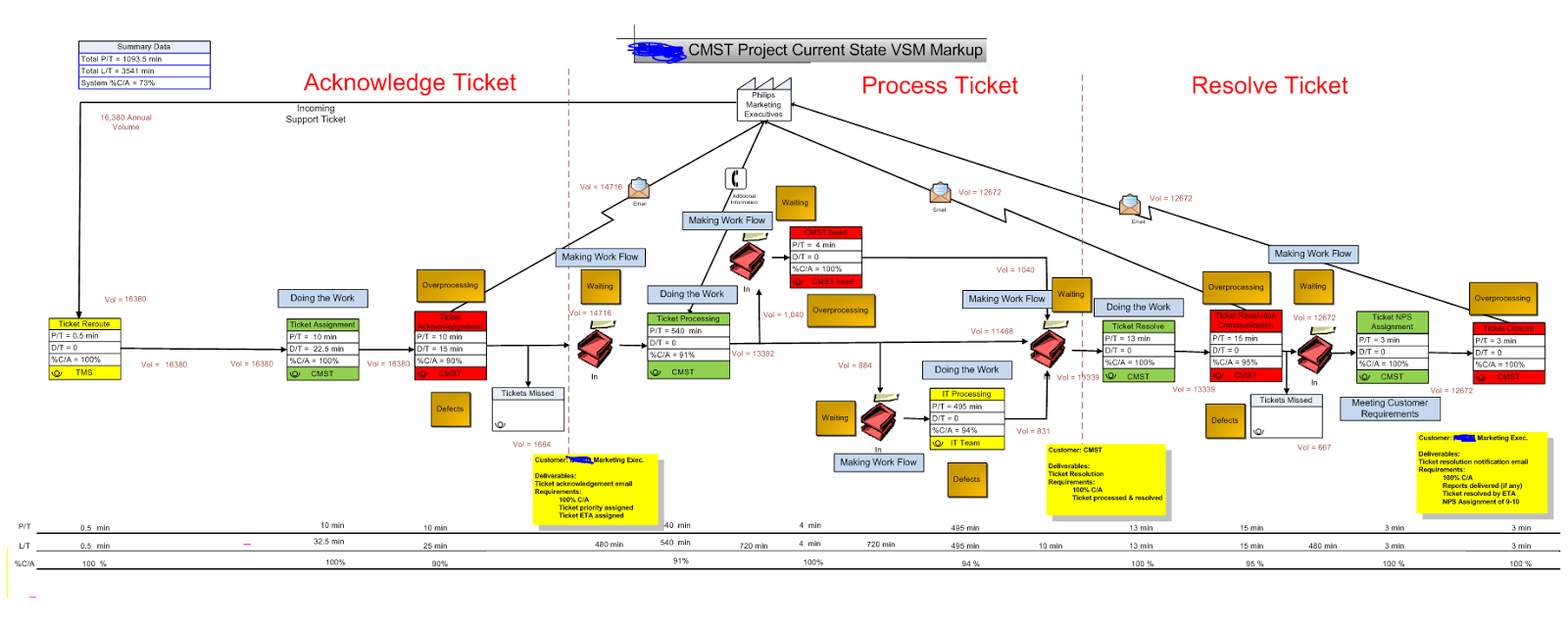
The next step in Value Stream Mapping is the Markup for the current state map. At this step, the bottleneck areas are identified in the current value stream map. As shown in the diagram below for the call center value stream map, a markup is created by identifying the bottlenecks at each step of the ticket resolution process. The type of bottleneck is also identified at this step such as Overprocessing, Defect, Waiting etc. These bottlnecks need to be removed and the process needs to be stream lined.


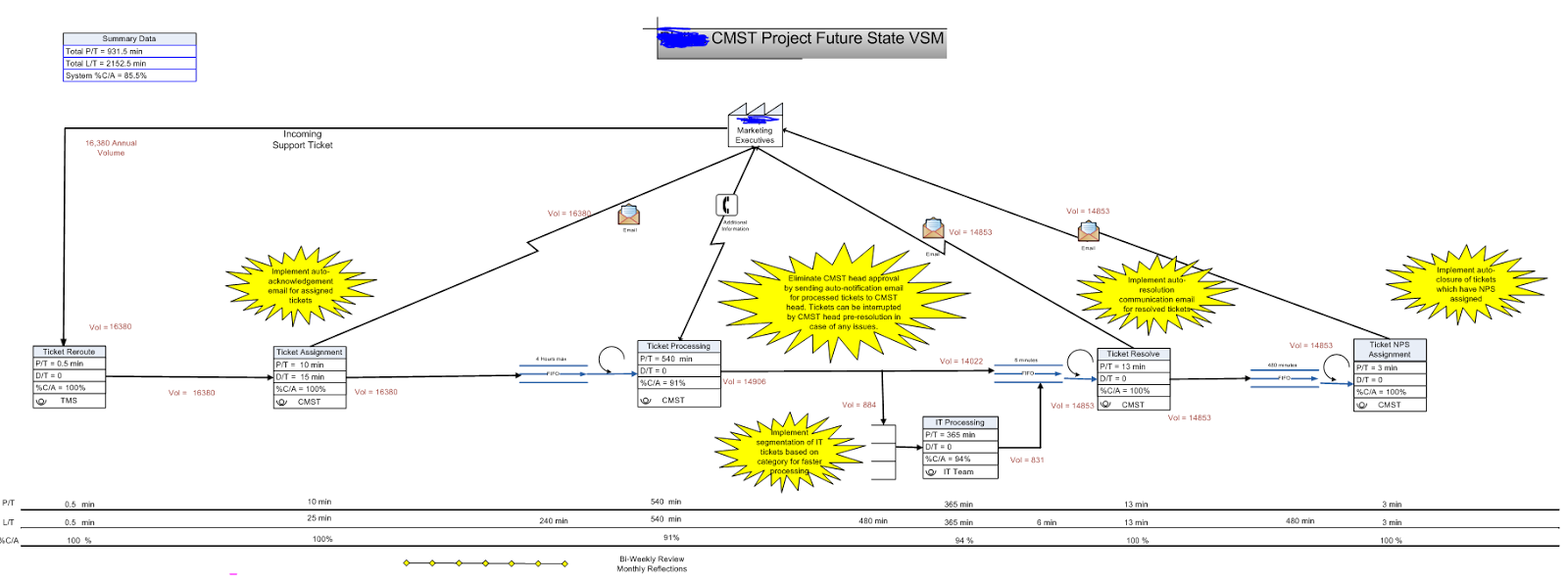
The last step in Value Stream Mapping is the Future State Mapping. In this step, the bottlenecks identified in the current state map markup are removed and the future streamlined process is documented as a diagram. The star bursts indicate the process improvements. The flow of the entity through the process is recorded. The volume of entities processed at each step of the process is also documented. Here is a sample future state diagram for a BPO call center that I created from a project that I worked on where "ticket" is the entity that passes through the process. The potential ticket volumes are recorder at each step. If you do not have the exact volumes, use a best guess estimate. The processing time and lead times are measured and calculated for each step. Click on the future state map image below to see full size image. This diagram was created using Microsoft Visio. Please leave any questions in the comments section below.


Monday, December 23, 2013

Capstone Project - Infosys China - Strategic Analysis

For my capstone project, I chose Infosys Technologies Limited, and did a strategic analysis of Infosys' decision to expand in China. The strategic analysis includes a background of Infosys Ltd, customer segments, geographic scope, timeline of the decision to expand in China, Macro-environment as well as Internal environment of the company in terms of its vision, mission, financial position and competitive advantage. 

Executive Summary


Infosys Technologies Limited, is adopting an aggressive expansion strategy in China, with a proposed investment of $125-150 million to set up its own state-of-the-art campus in Shanghai to build up service delivery capabilities and serve the local market. Infosys has traditionally been averse to acquisitions, held its premium pricing strategy and focused on its core IT enabled services business. However, the recent changes in the corporate leadership in 2011 and slowdown in growth, have prompted a strategic shift towards global expansion and moving up the value chain with consulting and technology partnership. The Chinese expansion decision comes at a time when Infosys is making a strategic shift towards global expansion through acquisitions and partnerships.
Infosys considers China as a potential market as well as potential resource pool for the company's global aspirations. Increasing competition with other multinationals for skilled IT professionals, soaring salaries in India and an emerging Chinese market were the main reasons for entering China as a low-cost center. However, China also presents significant challenges in terms of economic slowdown, political/legal issues such as government regulations and intellectual property protection, socio-cultural issues such as high attrition rates and low availability of English-speaking professionals, and increased domestic and international competition for labor and clients.
Infosys must look to expand in China as it is an important emerging market; most of its clients and other multinational companies are also moving into China and Infosys should not lose this opportunity. It should leverage its competitive advantage to attract employees and support its growth, but also keep a close watch on the external environment in China.

       I.            Overview of the Business

A.     Company Background

Infosys is a global consulting and an Information Technology (IT) Service Company, headquartered in Bangalore, India. It went public in India in 1993 and got listed on the United States of America (USA) NASDAQ in 1999. Infosys Limited was founded in 1981 by Narayana Murthy and six other people. Murthy, who was the CEO from 1981 and became the Chairman in 2002, retired in 2011 upon turning 65, and is now the Chairman Emeritus at Infosys. Infosys, most famously under the leadership of N.R. Narayana Murthy and Nandan Nilekani, came to define an industry that symbolizes modern entrepreneurial India, with legions of young workers converging on its Silicon Valley-style campuses[1]. Co-founder and chief operating officer S.D. Shibulal is the current CEO. Infosys has more than 153,000 employees. From a capital of US$ 250, Infosys has grown to become a US$ 7.126 billion (LTM Q2 FY13 revenues) company with a market capitalization of approximately US$ 28 billion.

B.     Industry(s) in which company competes

Infosys competes in the Software and Information Technology Services and Consulting industry and focuses on providing IT expertise, software design, development and maintenance services as well as on-site management and other IT functions to its customers. Driven by strong demand of IT infrastructure in developing economies, the global information technology industry is expected to grow at a rate of 5.88% during the period 2011-2015, according to a report by global research firm TechNavio[2].

C.      Customer segments served

Infosys offers business technology consulting, IT services and IT solutions in major industries such as Aerospace & Defense, Airlines, Automotive, Communication services, Energy, Financial services, Healthcare, High-tech, Hospitality and leisure, Insurance, Life sciences, Logistics and distribution, Manufacturing, Media & entertainment, Public sector, Retail and Utilities Industry. As shown in the following chart, the revenues are almost equally distributed across its five major customer segments.


D.     Products/services offered

Infosys provides end-to-end IT solutions which include software application development, testing and maintenance, business process management, infrastructure management and product engineering services. During the financial crisis, many companies cut down on IT costs. Infosys realized that in order to have sustainable growth, the company needs to move up the value chain and not simply be a low cost IT service provider.
Infosys has been shifting its strategy to increasingly offer platform and product solutions, which are geared towards providing much more value to its clients, getting more clients and delivering high value product and services in a cost effective way. Some of the popular products from Infosys are Finacle – Universal Banking Solution, Infosys Care Suite and Infosys Real-time Expertise Manager – Customer service products, Infosys Supply Chain Performance Management Suite, and SpeedSolve – Chat-based customer support product. Infosys also offers a suite of business platforms called “Infosys Edge”, that helps businesses simplify digital marketing, multi-channel commerce, manage IT asset performance, increase  employee engagement and accelerate long term growth and profitability[3].
Following is a graphical representation of Infosys revenue from product services offered in FY 2011. A bulk of the revenue is based on application development and maintenance of existing applications for its clients.

E.      Geographic scope of the business

The Infosys brand has moved out of India. Infosys has a global footprint with offices and development centers in 77 cities spread across 32 countries from Americas, Asia Pacific, Europe, Middle East and Africa. A bulk of the revenue is generated from managing the back-office computer systems of multinational companies in the US and Europe as shown in the following chart[4]. The company continues to expand at a great pace and is scouting for acquisitions in 'all geographies' to expand its overseas footprint.

F.      Business level strategy

The business model of Infosys is based on the Global Delivery Model (GDM), which takes advantage of the company’s global presence in delivering value to clients. Infosys pioneered the Global Delivery Model (GDM), based on the principle of taking work to the location where the best talent is available, where it makes the best economic sense, with the least amount of acceptable risk. Continued leadership around GDM enables Infosys to drive extraordinary efficiencies and free up clients’ resources for strategic transformation or innovation initiatives[5]. This means not only is Infosys becoming a global brand, but it also has the capability to support the global operations of multinational clients.
The company’s global presence allows its clients certain benefits which include the ability to work around the clock and business continuity. For example, if the client has working hours from 9 to 5 in the USA, the next shift picks up in India after 5pm in America and works when the USA office is closed. It also saves the customer from any disruption to its business in the event of say a natural disaster, as the business operations just get picked up by another location not affected by the disaster.
From the beginning, Infosys focused on “differentiation” strategy through innovation and quality and positioned itself as a premium IT service provider compared to its peers in the Indian IT services industry. In line with this, it also enjoyed higher margins of 25-30% as compared to its peers such as Wipro, TCS and Cognizant[6]. However, compared to its other global competitors such as Accenture, Deloitte and IBM, Infosys is a “low-cost” service provider.

    II.            Description and Brief Discussion of the Strategic Decision

A.     Strategic Decision

Recently, Infosys announced the expansion of its offices in China. Infosys is planning on establishing its own development center campus in Shanghai, Hangzhou and Beijing that can accommodate about 8000 employees, a sales office in Hong-Kong and a global education center in Jiaxing, with a proposed investment of $125-150 million. Infosys BPO, the business processing outsourcing arm of Infosys, is also setting up a new center in Dalian, China, with a 500-person capacity[7]. Though most Indian software firms have face difficulties in the Communist country, Infosys believes it’s all about perseverance and intends to hire 2,000 more employees, despite attrition rate climbing to an unusually high 20%[8]. In this paper, I will analyze Infosys’s strategic decision to expand operations in China and examine the strengths and weaknesses of Infosys as an organization as well as the opportunities and threats to Infosys as it pursues expansion in China.

B.     Time line and Timing of the Decision

Infosys established its first BPO centre in China in 2006. The decision to expand operations in China was announced in the late 2011 after 5 years of operating in China. Construction for the new projects has already begun. And when completed, the new centres will undertake projects in software development, IT services and IT-enabled services, and will also act as one of the training and research centres of the company. Infosys has big plans for China and sees it as a potential market for it to grow in terms of new clients and customers, and the low-cost high-skilled labor acts as a attractive source for the company to expand and setup new development centers outside India.

 III.            External Environment (Opportunities and Threats):

A.     Macro-environmental forces

1.      Economic

One of the reasons that encouraged Infosys to enter China in the early 2000s was the rapid growth of the Chinese economy which had attracted several multinationals, many of which were clients of Infosys. However in recent years, there has been an economic slowdown in China; while India’s stock market has soared in recent years, the opposite has happened in China.


China’s GDP growth rate has also been declining in the last ten years. Infosys will need to closely monitor the economic situation in China in the coming years.

2.      Political/Legal

The political environment in China also presents a higher degree of difficulty in conducting business as compared to India. India has a more laissez-faire attitude in both politics and business. China, being a communist nation, has greater regulation and involvement. Infosys had a first-hand experience of Chinese government regulation concerning the ownership structure, repatriation of profits and the shareholding pattern, when it first tried to establish a branch office and was given permission to set up a joint venture with the government[9]. Infosys was against the joint venture as both parties would have conflicting agendas; government with its political agenda of creating jobs and acquiring knowledge, and Infosys with its agenda for maximizing profit. Infosys then established a representative office and started working towards obtaining permission to establish a development center. These issues had delayed Infosys' Chinese venture but eventually Infosys set up Infosys Technologies (China) Co. Limited as a wholly-owned subsidiary in 2003 and Infosys Technologies (Shanghai) Co. Limited as a wholly-owned subsidiary in 2011.
The legal environment in China also poses a risk for Infosys in terms of Intellectual Property protection. Like India, the intellectual property laws are present, but not strictly enforced which results in software piracy and copyright infringement issues. When working with multinational clients in China such as banking, financial services or insurance, Infosys will need to strictly enforce governance standards to ensure intellectual property and sensitive data protection.

3.      Sociocultural 

Chinese programmers tend to have limited English-language skills are better equipped to understand and analyze material written in Chinese and to customize programs for the Chinese market. Infosys will need to invest in language and technical training of the employees to cater to multinational companies. Although the labor costs in China are lesser compared to India, Chinese employees are unlike Indian employees. Infosys has an extremely high attrition rate in China because the Chinese believe a 10-12% annual raise is not good enough[10]. Infosys will need to find alternate ways to engage the Chinese employees and get return on investment for its training and maintain its profit margin.

4.      Technological

The foreign companies entering China are looking at established players in the software industry, who could understand systems, technologies, procedures and standards in China, and Infosys does not want to miss this high potential business opportunity. The market for software and IT services in China is expected to grow exponentially and according to Gartner, Indian IT companies are expected to account for 40% of this market.

B.     Industry and Competitive Environment

1.      Existing Competitors

Infosys is competing globally with other Indian IT companies such as TCS, Wipro, HCL Technologies, and Cognizant for clients as well as human resources. The 2011 global market share of its competitors is as presented below.
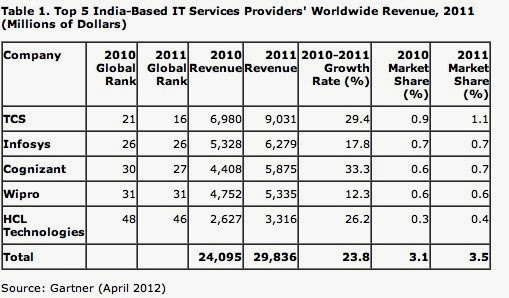
The most important reason for entering China was the soaring salaries of software professionals in India - a result of growing global demand for them[11]. With an increasing number of international firms such as IBM, Microsoft, Accenture, and Deloitte competing with Infosys for hiring from the same pool of software engineering professionals, the gap between the demand and availability of skilled manpower in India was likely to increase further, and India was estimated to witness a shortage of 250,000 workers in the IT industry by 2009, according to a study conducted by KPMG and NASSCOM. However, Infosys will still face intense competition in China from domestic software companies as well as foreign competitors who are also trying to expand Chinese operations, many of whom have entered China much before Infosys. However, China is undergoing a huge industrial revolution and is an important emerging market with a strong talent pool.

2.      Threat of Substitute Products or Services

Infosys provides a range of proprietary products and support services that can be customized to suit the business needs of its clients across multiple domains such as banking, retail and insurance as described earlier. However, similar bespoke products and services are also provided by its global competitors as well as domestic competitors in China, so there is a higher threat of substitute products and services with lower switching costs. Infosys has been known to acquire long-term project contracts with its clients in US and UK. In China, due to the highly competitive domestic software services industry that is vying for foreign clients, Infosys will need to price the projects right in order to gain long-term contracts[12].

3.      Bargaining Power of Buyers

Due to the presence of a large number of domestic and international IT companies in China the bargaining power of its customers has increased. Also multinational companies may prefer to switch to domestic IT and consulting companies to leverage the local knowledge.

4.      Bargaining Power of Suppliers

Infosys has to compete for skilled-labor with the global and domestic IT companies in China as well, which increases the bargaining power of its suppliers, who are mainly software and IT engineers. Software companies are known to poach employees by providing a “joining bonus”. This may eventually drive up wage levels, just like in India, making it more difficult to attract and retain employees.

5.      Barriers to Entry

The Chinese government regulations present significant barriers to entry to international IT companies. However, there are relatively lower barriers to entry to domestic IT companies, except in terms of technological infrastructure requirements.  

  IV.            Internal Environment (Strengths and Weaknesses):

A.     Mission

Infosys’s Vision and Mission are important drivers of its strategic decisions. The vision statement “We will be a globally respected corporation” reflects its intent for going global and expanding globally. The mission statement “Strategic Partnerships for Building Tomorrow’s Enterprise” reflects a desire to acquire or partner with the right company with complementary expertise. Infosys Chief Executive Officer and Managing Director S. D. Shibulal articulates his vision of the smart enterprise by focusing on “emerging economies” as one of the key drivers of business. In light of these views, the decision to expand into China clearly supports Infosys’s mission of becoming a global enterprise.

B.     Financial Position

Reviewing the financial statements of Infosys at the time it entered China, Infosys' global revenues increased by 33.5% from Rs 71.3 billion in the financial year 2004-05 to Rs 95.2 billion in the financial year 2005-06. However, its Chinese subsidiary had incurred loss of Rs 166 million on revenue of Rs 260 million. The reason for this loss, Infosys said, was that though it was able to secure some local clients, it was unable to attract foreign companies operating in China to procure its services[13]. By altering its premium pricing strategy and leveraging its competitive advantage with existing multinational clients in China, Infosys has been able to gain a sturdy financial position in China and has been listed as the Top 10 global service providers in China by the China council for International Investment Promotion[14].
Infosys is in a strong financial position with revenue of more than $6 billion in 2011. Infosys has been consistently enjoying not only financial success but also a very high price-equity ratio that gives it an excellent valuation on the stock markets and a blue chip status. This implies that it has the capital to expand, and also the basis to leverage potential investors. Infosys hopes that its Chinese operations would contribute 10% of its total revenues by 2015[15].

C.      Sources of Competitive Advantage

Infosys has a strong brand recognition in the IT industry in India and abroad. It was the first Indian company to list on a US Stock Exchange. It is ranked among the 50 most respected countries in the world by Reputation Institute’s Global Pulse 2009. It has also been voted most admired Indian company in the Wall Street Journal Asia since 2000. The strong brand identity would definitely help Infosys in attracting employees as well as new clients in China. Many of Infosys’s existing clients have moved into China, and they might prefer to continue their strategic IT alliance with Infosys to leverage existing knowledge and keep learnings within the company. Having Infosys located in China, will give the proximity advantage for customer service that Infosys maintains with its on-site client locations.
Infosys China office has been operational since eight years and has served as an additional base for global customers. The time zone difference between the western countries and China will help Infosys leverage its Global Delivery Model effectively. The low labor-cost advantage will also help Infosys in maintaining its profit margins and differentiation strategy while providing value-creation products and services to its clients.
Infosys has a comprehensive portfolio of solutions as well as IT quality standard certifications such as CMM Level 5i and Six Sigma expertise to differentiate from domestic competitors in China. Infosys also has excellent infrastructure, telecommunication facilities and the capability of global 24/7 delivery through its development centers in other locations, which gives it a competitive advantage over the domestic competitors.
Infosys has been awarded the No. 1 spot globally for its corporate governance practices and No. 2 spot for its financial disclosures policies by IR Global Rankings (IRGR). IRGR is the most comprehensive technical ranking system for investor relations websites, corporate governance practices and financial disclosure procedures[16]. This will definitely provide Infosys a competitive advantage compared to other IT companies in China, which has a weak legal structure.
Despite being a huge IT company compared to its Indian competitors such as TCS, HCL, Wipro and Cognizant, Infosys is much smaller than its global competitors such as IBM, HP and Accenture. Infosys generated $6 billion in 2011, which is relatively low in comparison with large global competitors such as Hewlett-Packard ($91 billion), IBM ($91 billion), EDS ($21 billion) and Accenture ($18 billion)[17]. Also, Infosys’ Chinese office has been operational for only eight years, so it has relatively less experience in China than some of its other international competitors.
Infosys has also been struggling with high attrition rates of 14.9% in 2012 due to wage-hike issues. These attrition numbers are thrice as much as the general industry rate[18]. Infosys will need to revamp its human resource strategy in China to prevent a high attrition and retain its resource knowledge and capabilities within the organization.
Infosys does not have experience with acquisitions and has traditionally been averse to acquisitions; its first acquisition was Lodestone Holding AG in Switzerland in October 2012. There is a significant learning curve from incorporating another company, especially when the parent company has a strong corporate culture. As Infosys plans aggressive expansion in China through acquisitions, it should look to find a suitable company with a similar corporate culture to avoid any culture clashes that create disharmony within the organization.

D.     Corporate Governance

In the last ten years, after founder Narayan Murthy stepped down as CEO, Infosys has had four CEOs, with each of the co-founders taking a shot at leading the company. This has affected the company’s growth and critics say that Infosys is overly focused on service delivery and not enough on sales; that it is slavish to preserving margins at the expense of winning new business[19]. Infosys’s new CEO S.D. Shibulal who took over in 2011 is the main driver behind the strategic shift towards global expansion through acquisitions.

E.      Corporate Culture

Infosys has a strong corporate culture, where each employee is treated as part of the Infosys family and referred to as “Infoscion”. It invests in its employees with a long-term goal and trains them to become global employees, so as to facilitate easy movement of resources between different development centers and client locations. It is common for employees to rotate between on-site client locations and off-shore development centers. Customer-centric focus is a strong part of the corporate culture and the company urges its employees to work towards “customer delight” and not simply “customer satisfaction”. Infosys’ approach in China is also with a long-term view of obtaining skilled resources to join the Infosys “family” and work towards creating a strong skilled labor base.

F.      Code of Ethics

Infosys is a highly respected IT company that considers ethics critical to its business strategy. Although Infosys is targeting China mainly for low-cost labor, it is focused on delivering long-term value to its employees, shareholders and society[20]. Many manufacturing companies like Nike are known to take advantage of the low-cost labor in China through sub-contractors, which can cause labor law violations and worker exploitation. Infosys is known to invest heavily in training its employees to support the long-term goals of the company and not exploiting its employees for short-term gains. Infosys’ long-term goals in China are evident from the $125-150 million investment in establishing its own campus in Shanghai versus subcontracting to local IT companies in China.

     V.            Global Ethics and Social Responsibility Considerations

Infosys has been consistently viewed as the most transparent and ethical organization by the customers, employees, society and the investor community. Infosys's founder and Chairman Emeritus, Narayanamurthy, has always been a great follower and advocate of ethics in business. While a number of organizations today are engaged in window-dressing their accounts and also are trying to communicate a performance far better than the actuals, with a view to inflating their valuation, Infosys always followed the policy of naked transparency in front of the investing community, through their ' When in doubt, disclose' approach[21]. Infosys was ranked among 'India's Best Companies to Work For - 2009' in a survey by the Great Place to Work® Institute India in collaboration with The Economic Times. Infosys featured among the best companies for large organizations and corporate social responsibility.

  VI.            Final Conclusion and Summary

With the slowing growth rate in the last ten years in US and Europe due to economic slowdown, a turbulent corporate leadership at Infosys, growing pressure from the shareholders, the increasingly competitive skilled-labor situation and soaring salaries in India and an emerging market in China, I think Infosys’ China expansion is a need of the hour. However, Infosys will need to keep


[1] Arakali, H., & Chatterji, S. (2012, May 7). Infosys woes prompt calls for change at top| Reuters. Business & Financial News, Breaking US & International News | Reuters.com. Retrieved December 15, 2012, from http://www.reuters.com/article/2012/05/07/us-india-infosys-idUSBRE84606420120507
[2] Global information technology market to grow by 5.88% until 2015: TechNavio - Computer Business Review. (2012, May 15). IT Services Industry News - Services - Computer Business Review. Retrieved December 14, 2012, from http://itservices.cbronline.com/news/global-information-technology-market-to-grow-by-588-until-2015-technavio-150512
[3] Infosys Products and Platforms. (n.d.). Infosys - Business Technology Consulting | IT Services | Enterprise Solutions. Retrieved December 14, 2012, from http://www.infosys.com/products-and-platforms/Pages/platforms.aspx#platforms s
[4] Supplier profile: Infosys. (n.d.). ComputerWeekly.com. Retrieved December 14, 2012, from http://www.computerweekly.com/guides/Supplier-profile-Infosys
[5] Infosys - About the Company. (n.d.). Infosys - Business Technology Consulting | IT Services | Enterprise Solutions. Retrieved November 13, 2012, from http://www.infosys.com/about/Pages/index.aspx
[6] Is it time Infosys cut prices? (2012, September 10). Business Standard. Retrieved December 14, 2012, from http://www.business-standard.com/india/news/is-it-time-infosys-cut-prices/485837/ 
[7] Mishra, B. R. (2011, December 28). Infosys BPO to expand in China. Business Standard. Retrieved November 12, 2012, from http://www.business-standard.com/india/news/infosys-bpo-to-expand-in-china/459980/
[8] Hector, D. J. (2012, March 13). Infosys to hike China head count, retain best workers.Financialexpress.com. Retrieved January 4, 2012, from http://www.financialexpress.com/news/infosys-to-hike-china-head-count-retain-best-workers/923032/
[9] Infosys in China. (2006). IBS Center for Management Research. Retrieved December 14, 2012, from http://www.icmrindia.org/casestudies/catalogue/Business%20Strategy/Infosys%20in%20China.htm
[10] Hector, D. J. (2012, March 13). Infosys to hike China head count, retain best workers.Financialexpress.com. Retrieved January 4, 2012, from http://www.financialexpress.com/news/infosys-to-hike-china-head-count-retain-best-workers/923032/
[11] Infosys in China. (2006). IBS Center for Management Research. Retrieved December 14, 2012, from http://www.icmrindia.org/casestudies/catalogue/Business%20Strategy/Infosys%20in%20China.htm
[12] Fung, E. (2011, September 15). Infosys China CEO: Will Continue to Expand Organically - WSJ.com. The Wall Street Journal. Retrieved December 14, 2012, from http://online.wsj.com/article/SB10001424053111904060604576572211692441924.html
[13] Infosys in China. (2006). IBS Center for Management Research. Retrieved December 14, 2012, from http://www.icmrindia.org/casestudies/catalogue/Business%20Strategy/Infosys%20in%20China.htm
[14] Infosys ranked among the Top 10 Global service providers in China. (2012, July 13). Infosys Press Release. Retrieved December 15, 2012, from http://www.infosys.com/newsroom/press-releases/Documents/2012/global-service-providers-award.pdf
[15] Infosys in China. (2006). IBS Center for Management Research. Retrieved December 14, 2012, from http://www.icmrindia.org/casestudies/catalogue/Business%20Strategy/Infosys%20in%20China.htm
[16] Infosys - Corporate Governance Practices | IR Global Rankings. (n.d.). Infosys. Retrieved December 15, 2012, from http://www.infosys.com/newsroom/press-releases/Pages/corporate-governance-practices.aspx
[17] Infosys SWOT. (n.d.). Marketing Teacher. Retrieved December 14, 2012, from http://www.marketingteacher.com/swot/infosys-swot.html
[18] Iyer, S. (2012, July 16). Infosys attrition number is the real shocker | Firstpost. Latest News: Breaking/Live News Today, Latest News India, Politics News, Business/Stock Market News, Sports Updates, Bollywood News and Opinions - Firstpost.com. Retrieved December 14, 2012, from http://www.firstpost.com/business/infosys-attrition-number-is-the-real-shocker-378976.html
[19] Fung, E. (2011, September 15). Infosys China CEO: Will Continue to Expand Organically - WSJ.com. The Wall Street Journal. Retrieved December 14, 2012, from http://online.wsj.com/article/SB10001424053111904060604576572211692441924.html
[20] Code of Conduct. (n.d.). Infosys. Retrieved December 15, 2012, from http://www.infosys.com/investors/corporate-governance/Documents/CodeofConduct.pdf
[21] Srinivas (2012, July 30). Secrets of Successful Organizations..: BENCHMARK FOR BUSINESS ETHICS- INFOSYS & & TATA GROUP. Secrets of Successful Organizations.. Retrieved December 15, 2012, from http://mastermentorsadvisory.blogspot.com/2012/07/benchmark-for-business-ethics-infosys.html